
It has been said that the Black and Tan Russell Terrier or Hunt Terrier as they are referred to today, never existed except in the minds of Victorian picture book makers. However, not only are there many photographs of the black and tan terrier from long ago, but many books describe these loyal little dogs. From the writings of Rawdon Briggs Lee, an author of many books on dogs from the nineteenth century and a judge at the dog shows, we know today that there was, and still is, a short, black and tan terrier.
Documentation of the black and tan terrier can be traced as far back as the 1600’s. In 1686,“The Gentleman’s Recreation” stated that the terrier is a very small dog used for hunting the fox and the badger. In 1760,“Field Sports” documented of two types of terriers.
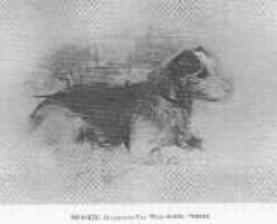
They were described as rough and short legged, long backed, very strong, normally black and tan in color or yellowish, smooth-haired and beautifully formed, having a shortened body and more sprightly appearance, generally, reddish brown color or black with tan legs.
The original black and tan terriers were common among the farms of England, Ireland, Holland, Germany, and likely many more countries as well. They were bred for working and working only. The black and tan terrier ran about the stable yards, hunting and tracking vermin. Many black and tan terriers were used to drive fox from their holes, hunting rabbits. They were used not only keep the vermin under control at the homestead, but also for hunting and sporting purposes. In recent years, the “Hunt Terrier” has been bred for companionship to become a household pet, while retaining hunting abilities.
This little terrier was a very common breed hundreds of years ago and is the foundation of many of the breeds we know today.
The original black and tan terriers were common among the farms of England, Ireland, Holland, Germany, and more than likely many more countries. They were breed for working and working only generations ago.
As a hunting dog, he is querulous, fretful, and irascible, high spirited, and alert when brought into action.
A Timeline:
-1686, “The Gentleman’s Recreation” states the terrier is a very small dog used for hunting the fox and the badger.
-1760:“Field Sports” writes of two sorts of terriers. Rough and short legged, long backed, very strong, normally black and tan in color or yellowish, smooth-haired and beautifully formed having a shortened body and more sprightly appearance, generally, reddish brown color or black with tan legs.
-1800: Cynographia Britannica published this about terriers: The most distinct varieties are crooked legged and straight legged, their colors generally black with tan legs and muzzles, a spot of the same color over each eye. Sometimes the terrier is reddish or fallow, white, or pied.
-1802:“Rural sports” describes the terrier as a stoutly built dog made along the lines of a fox terrier. The common terrier of this time was for the most part black and tan in color with white on his feet and chest.
-1803: “Sporting dictionary” says terriers of even the best blood are now breeding in all colors. Red and black with tan faces, flanks, and legs, brindled or sandy, some few brown pied, white pied, and pure white as well as one sort of each color, rough and wire haired were some of the descriptions.
The weight of these terriers mentioned through out these hundreds of years is on an average 7 to 17 pounds.
-1859: Saw the first dog show. No prizes were offered for the terriers that year. The following year,1860, classes were offered for the black and tans, white, other English terriers, and toy terriers.
It is noted on more than one occasion that sometime between 1850 and 1860 the black and tan terrier was being crossed with a grey hound or whippet giving him a long lean head, arched back, tucked up loins, and long feet. Along with these changes to the black and tan terrier came round full glaring eyes instead of the smart, piercing, almond-shaped eyes.
By the 1894 Liverpool show, these specimens, for the most part, took the leading prizes, hence, the birth of the Manchester terrier. The Manchester Terrier Club was also founded this same year.
At the dawn of the 20th century, the red hunt terrier and the black and tan hunt terrier were near extinction. Because of the black and tans great hunting ability, small size, intelligent look, and loyal companionship, he was being used as the foundation for many other breeds. As was mentioned earlier, the gentlemen’s terrier was the Manchester Terrier. The sporting breed was the Bull Terrier and the huntsmen, in need of a dog that was white, as to tell the difference between the dog and the prey, used the Fox Terrier breed, and a smaller version better for the underground work was the Jack Russell Terrier.
The black and tan terrier and the red terrier, became so common throughout all of Europe, England, etc., thoughts of this breed becoming extinct were unheard of. Yet, a club for these little terriers true to the excellent qualities still was not organized or, perhaps was, but did not prosper.
After World War I, Germany was focused on getting rid of ALL “foreign” breeds and bringing back what they considered “extinct” German breeds. During this time, they did not travel beyond the boundaries of Germany for these dogs.
Lutz Heck was the pioneer of this peculiar quest recruiting many others. They started with only 8 black and tan fox terriers. At one time, there were 700 dogs in the kennels, and, after only 10 years the project was complete. The black and tan color was prominent. The coat and look of the dog was being thrown every time. Those not meeting the requirements were not acknowledged. This German variety of the black and tan terrier became known as the Jagdterrier or German Hunt Terrier.
The first dog was sold in 1938 to a German man by the name of Max Theil Sr. In 1951, Theil came to America with two female dogs, one of which was breed. By 1956, there were 9 Jadgterrier owners in the US. They formed the Jagdterrier Club of America. Unfortunately, the club did not prosper in America, at that time, and eventually fizzled out. This terrier is bigger, and holds some resemblance to the modern day Fox Terrier.
In recent years a “new” line of Jagdterrier has been imported into the US. This line is a bit smaller and more refined. In the U.S., it is at the smaller end of the breed standard. These terriers, both black and tan in color and red, are not only being imported from Germany, but also Ireland, Holland, and England.
In 1995, The Hunt Terrier Club of America was formed; however, at the beginning of 2008, they revised their charter to accept a much wider variety of color, size, shape etc., which no longer met the breed standard of the original black and tan or red Hunting Terrier.
The American Hunt Terrier Club Association was organized in 2008, with the goal of preserving the original Hunt Terrier, accepting “only” the original black and tan or red hunt terrier as described from years ago. We are a dedicated registry set out to preserve and promote these little terriers.
The American Hunt Terrier is a well balanced terrier, small, yet strong and agile terrier, a little longer than tall.Chest is deeper than it is wide, legs are well muscled and half the terrier’s height. The head has a moderately broad, flat skull with button drop ears.
Skin is thick with a dense coat. The coat can be rough, smooth, or broken. Tail is normally docked and held high.
Solid tan (from a deep reddish tan to a light lemon tan), solid black, or black with tan or red points are acceptable colors. Solid white or predominantly white is not allowed. Legs and belly must not be white. A small amount of white on the chest or feet is acceptable.
Today’s American Hunt Terrier is bold, notoriously fearless, loyal, friendly, active, and alert. His swift and fluid movements match his intelligent expression.
This is a high energy breed, happiest in an environment where there is plenty of regular activity.